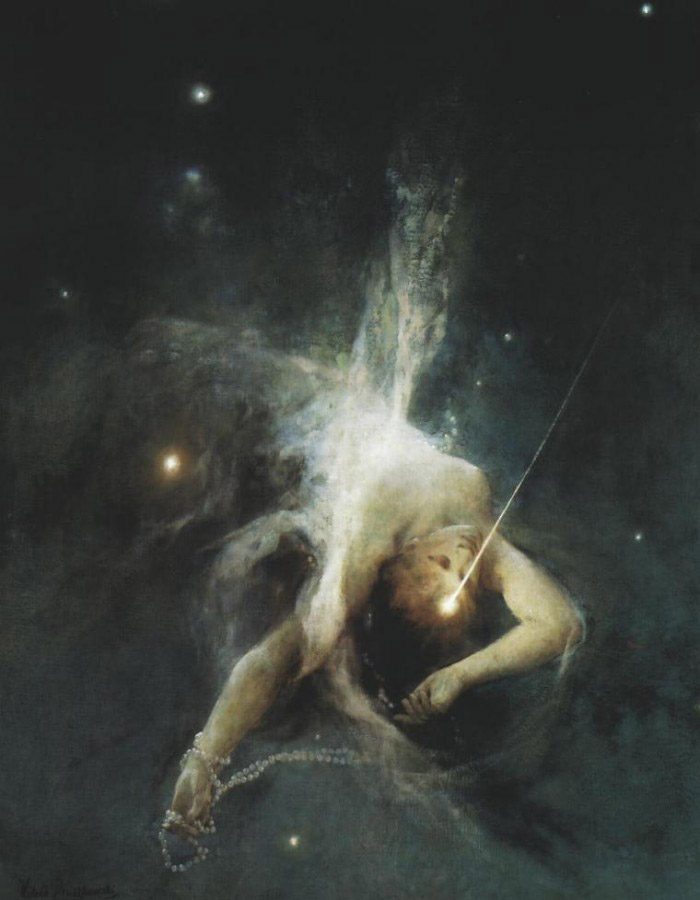
Unless you're a Mason or a Biblical scholar, or are still mind-boggled at the over-literalness of Josh the Baptist, our Kentucky minister friend with whom we had online conversations during the past month, you might want to just skim this entry quickly and move on. But before you do, note that this piece ends with a link to Beat poet Allen Ginsberg's epic Howl, which I bet you haven't read or heard lately. I once saw Ginsberg read it / recite it / rant it. Wow.
In a way-too-long article at Bible-Truths.com, we find references to Lucifer and the King of Tyre. Written from a devoutly Christian but definitely not literalist point of view, author L. Ray Smith proves that Lucifer referred to in that famous passage of Isaiah 14:12 — "How art thou fallen from heaven, O Lucifer, son of the morning!"— is not and never was intended to be Satan.
By pointing out all the other uses of the same Hebrew word eiliu (and variations) in Isaiah, Jeremiah, Ezekiel, Hosea and other Prophetic books, he shows that the Latin word "Lucifer" should never have been used in the famous verse. He says that word should properly have been translated as "howl."
He writes:
... I will list the King James renderings of the word that is found in the "Hebrew" texts and transliterations of its various forms in every occurrence in the entire KJV Bible. Now you can be the judge. In all Hebrew of Aramaic texts of Isa. 14:12, the only word found is "heh-lehl," eill, which is a form of the Hebrew stem "yah-lahl," ill, meaning howl. Here is Kittel’s Hebrew Text for the Hebrew Stem ill — "yah-lahl" — HOWL:I'm thinking this pretty much gets Freemasons off the hook as far as being "devil worshippers," since most people who say that about Masons base their opinion on the fact that Albert Pike, the man who rewrote the Masonic Scottish Rite rituals and who wrote thd 861-page Morals and Dogma seemed to praise "Lucifer."
Isa. 13:6 eiliu Howl ye
Isa. 14:31 eili Howl
Isa. 15:2 iilil shall howl
Isa. 15:3 iilil shall howl
Isa. 16:7 iilil Howl
Isa. 16:7 iilil shall howl
Isa. 23:1 eililu Howl ye
Isa. 23:6 eililu Howl ye
Isa. 23:14 eililu Howl ye
Isa. 52:5 eililu make to howl
Isa. 65:14 eililu shall howl
Jer. 4:8 ueililu Howl
Jer. 25:34 eililu Howl
Jer. 47:2 ueill and shall howl
Jer. 48:20 eilili Howl
Jer. 48:31 ailil will I howl
Jer. 48:39 eililu They shall howl (Howl ye)
Jer. 49:3 eilili Howl (Howl ye)
Jer. 51:8 eililu howl
Ezek.30:2 eililu Howl ye
Hos. 7:14 iililu They howled
Joel 1:5 ueililu And howl
Joel 1:11 eililu howl
Joel 1:13 eililu And shall be howlings
Amos 8:1 ueililu and howl
Micah 1:8 uailile howl ye
Zeph. 1:11 aililu Howl
Zech.11:2 eill howl
Zech.11:2 eililu howl
Isa. 14:12 eill Lucifer (??)
I don’t believe one has to be a Hebrew scholar to see at a glance that "Lucifer" is totally out of place in this list. The meaning of this word is clear; eill is a verb that means "howl", and not a noun than can be twisted into a personal name such as "lucifer"!
Lucifer, as we know, means Light-Bringer, and nowhere except in people's minds has it ever meant "Satan" or "the Devil." And yes, Masons seek Light, so they'd be happy to see a Light-Bringer coming.
But the Light-Bringer isn't the Devil.
Smith convincingly points out that the entire passage in Isaiah where Lucifer is mentioned is referring to the King of Babylon during that time period.
Here he points out each pronoun, each time showing it refers to the King of Babylon. (See entire chapter for original context.) Then... suddenly... for no obvious purpose but simply driven by a misplaced stylus-stroke by a scribe, he says, "Lucifer" is created out of nothing.
"All they shall speak and say unto thee [king of Babylon], Art thou [king of Babylon] also become weak as we? Art thou [king of Babylon] become like unto us [mere mortals and not gods from heaven]. Thy [king of Babylon] pomp is brought down to the grave, and the noise of thy [king of Babylon] viols: the worm is spread under thee [king of Babylon], and the worms cover thee [king of Babylon]. How art thou [king of Babylon] fallen from heaven, O Lucifer…"?!?
Here is how the Concordant Literal Old Testament translates this verse by following the Hebrew Manuscripts rather than the Catholic Latin Bible: "How you have fallen from the heavens! Howl, son of the dawn! You are hacked down to the earth, defeater of all nations."
* * *
All this talk of howling reminds me of Allen Ginsberg's epic poem Howl. If you've never heard Ginsberg read it or read it yourself, you're missing something amazing. Warning: It contains words and images some people find offensive.
Lucifer | Bible | Beat Poetry

0 comments:
Post a Comment